
Colosseum, Forum & Palatine
Explore the Colosseum, Roman Forum and Palatine Hill with an expert local guide and priority access to Ancient Rome.
Check availabilityA city guide by Elisa
Rome reveals itself in layers. A temple survives inside a church, an emperor’s tomb becomes a papal fortress, and the city keeps building new stories on top of old ones.
Use the map to find your way. Then open each place for the detail worth noticing, practical information and a direct link to its location.

01 / EXPLORE
Seventeen stops, from Ancient Rome to the Vatican. The map shows the first fourteen; the final three are marked in the list.
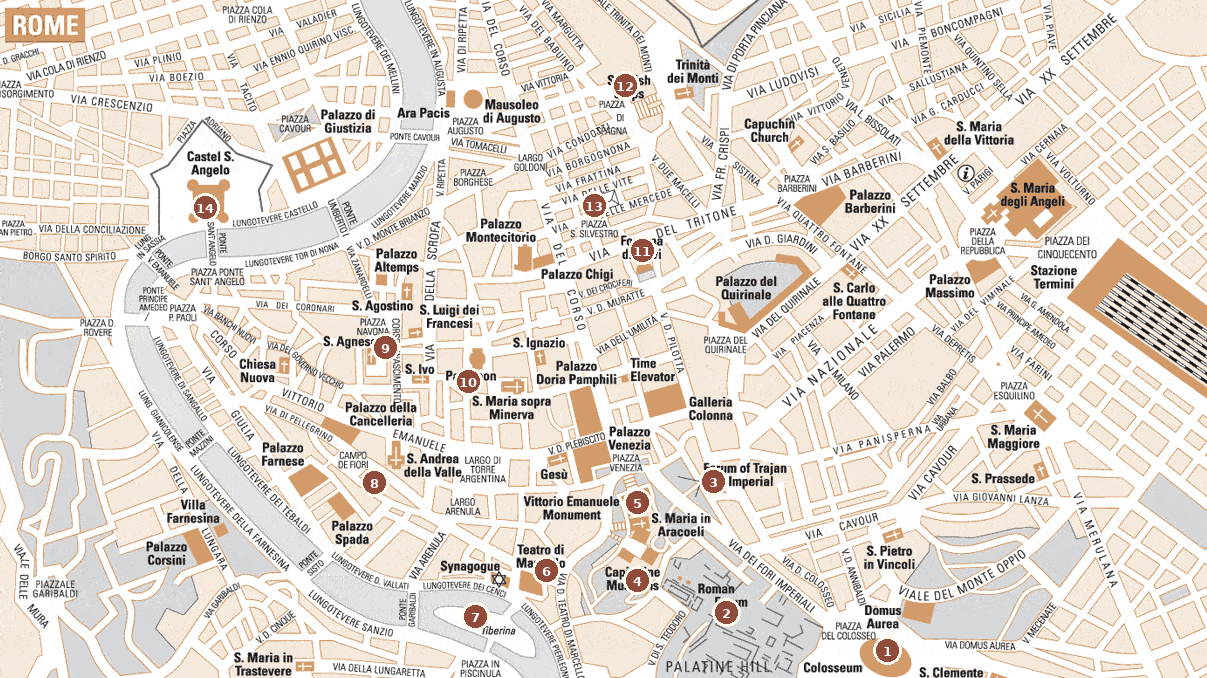
On a phone, swipe the map sideways to see it all. Tap the map to open it full size.
The arena’s real marvel was hidden below it: lifts, trapdoors and corridors could make animals and scenery appear suddenly before the crowd. Even its familiar name came later, probably from Nero’s colossal statue nearby rather than from the amphitheatre itself.
The Forum was ancient Rome’s stage for politics, religion, triumph and reputation. Above it, emperors filled the Palatine with residences so magnificent that the hill’s name eventually gave us the word “palace”.
Each emperor used architecture as autobiography. Trajan’s Column is the clearest example: a continuous stone narrative winds upward like an ancient film reel, turning military conquest into a story designed to outlive him.
Michelangelo deliberately turned the square away from the ancient Forum and toward the new papal city. The famous she-wolf is here too, but the twins Romulus and Remus were added centuries after the animal was made.
Romans have compared the Vittoriano to everything from a wedding cake to a typewriter, yet its terraces offer one of the clearest readings of the city: imperial ruins, medieval towers, Renaissance palaces and Baroque domes in a single view.
The Theatre of Marcellus never became a frozen ruin: medieval fortifications and later apartments grew directly above its ancient arches. Nearby, Roman-Jewish cuisine preserves a history shaped by restriction, ingenuity and extraordinary continuity.
The island has been linked with healing since antiquity, when a sanctuary to Aesculapius was built here. Its stone embankments were shaped like a ship, as if the entire island were sailing through the Tiber.
The flowers in the name came before today’s market stalls. At the centre, Giordano Bruno faces the Vatican from beneath his hood—a philosopher executed here in 1600 and later transformed into a monument to freedom of thought.
The square is long and curved because it still follows Domitian’s ancient stadium beneath your feet. Even the name remembers the games: “in agone” slowly changed through everyday speech until it became “Navona”.
The oculus is not simply an opening: its circle of light travels across the dome and walls like a giant celestial clock. When rain enters, the slightly convex floor guides the water toward a discreet ancient drainage system.
The fountain is really the theatrical façade of a palace, fed by an aqueduct whose origins reach back to 19 BC. Behind Oceanus, hidden rooms still control the exact flow that makes the stone appear alive.
The staircase was financed by a French diplomat, leads to a French church and took its English name from the Spanish Embassy below. Its three flowing sections are often read as a reference to the Trinity.
The elegant shopping street owes its name to a far less elegant spectacle: riderless horse races once thundered along this route during Roman Carnival, the “corso” that transformed the street’s identity.
Hadrian’s tomb became a fortress, prison and papal refuge. The covered Passetto di Borgo linked it to the Vatican, while the angels on the bridge turn the final approach into a procession through the instruments of Christ’s Passion.
For travellers arriving from the north, this was Rome’s monumental first impression. The so-called twin churches are not truly identical: their domes and plans were adjusted to disguise the unequal spaces behind them.
Bernini described the colonnades as the Church’s maternal arms embracing the world. Stand on one of the marked discs in the square and the four rows of columns suddenly align, collapsing into a single perfect row.
These are museums in the plural because centuries of papal collections grew into an entire city of galleries. The Sistine Chapel was designed with proportions traditionally associated with Solomon’s Temple and still becomes the sealed theatre of a conclave.
Opening hours, tickets and access can change. Check the official sites before visiting.
02 / EXPERIENCES
Guided visits and experiences for the stories you want to spend more time with.
Explore the Colosseum, Roman Forum and Palatine Hill with an expert local guide and priority access to Ancient Rome.
Check availability
Discover the Vatican Museums and Sistine Chapel with an expert guide, exploring masterpieces by Michelangelo and Raphael.
Check availability
Join the Wednesday Papal Audience with guided assistance, Vatican history and help navigating the experience in St Peter’s Square.
Check availability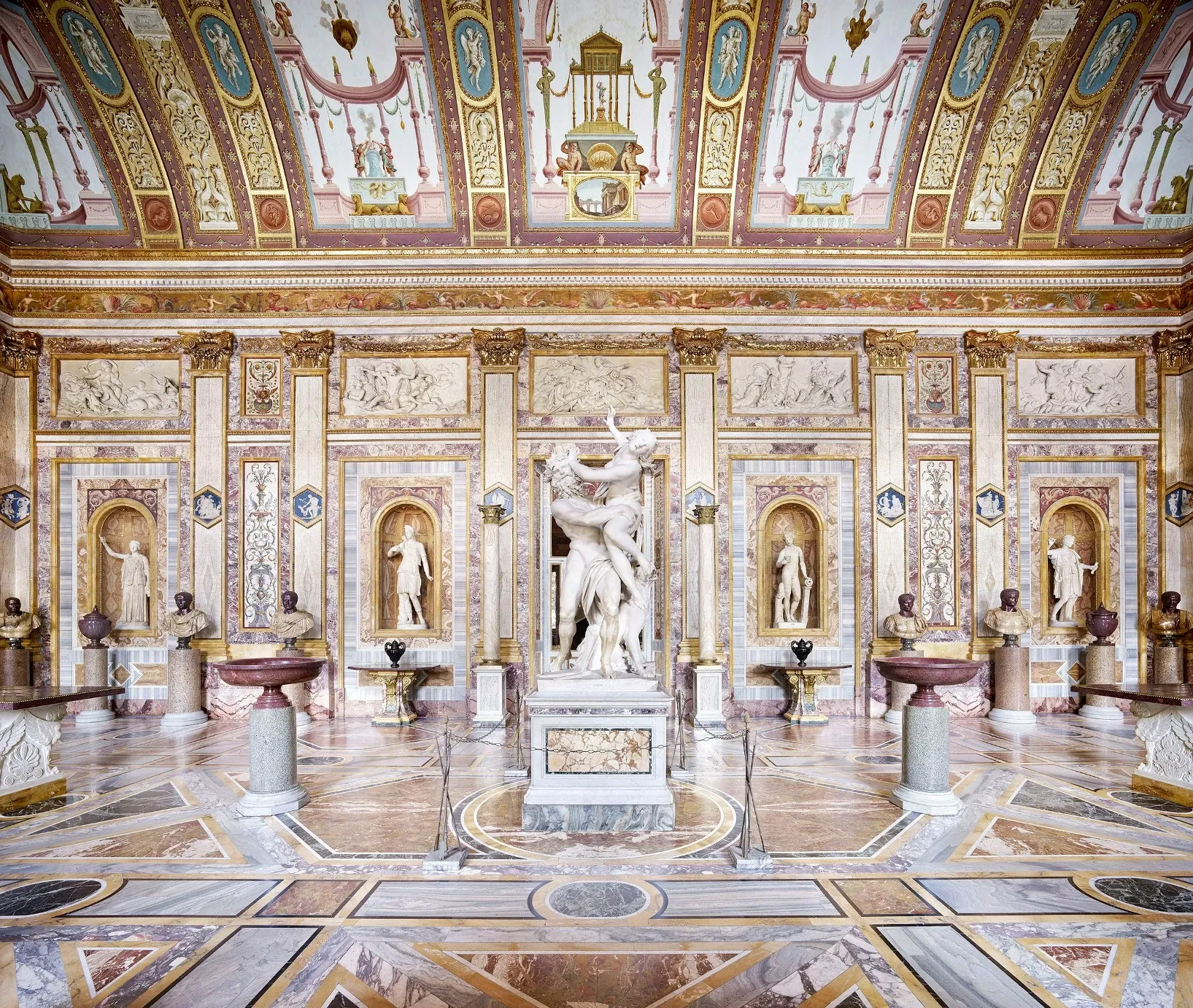
Explore one of Rome’s finest art collections with an expert guide, from Bernini’s sculpture to Canova and Renaissance painting.
Check availabilityUse code ELISAB5 for 5% off eligible experiences. See more Rome experiences ↗
03 / LOCAL PICKS
Gelateria della Papessa, near the Spanish Steps. Classic flavours and more unexpected combinations.
Find it on Google Maps ↗Restaurants, artisans and rooftops will join this guide as I select places I can recommend.